
Making Tax Digital · Sole traders · Landlords
Why Open Banking is the secret to stress-free tax compliance.
ONLY£15A MONTHHow Open Banking can reduce bookkeeping admin, what read-only access means, and where bank feeds fit into your MTD routine.
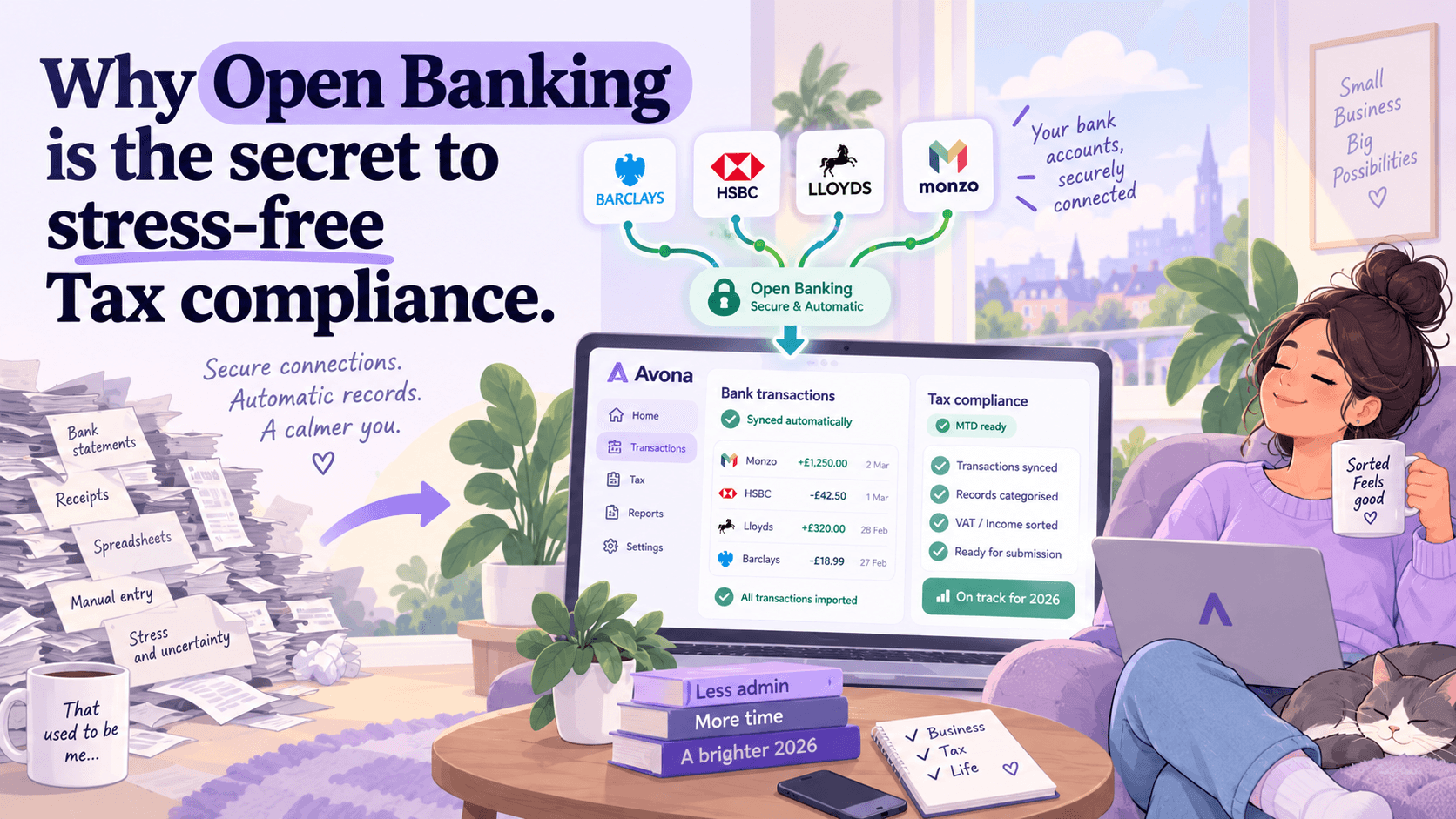
Ask a room full of sole traders and landlords which administrative task they would happily hand over, and bookkeeping is likely to come up. For years, managing finances has meant bouncing between bank statements, faded receipts and spreadsheets.
Making Tax Digital (MTD) for Income Tax began its first phase in April 2026. For those in scope, digital business records and quarterly updates now form part of the reporting routine. A bank feed can make keeping those records up to date much easier.
That is where Open Banking comes in.
What exactly is Open Banking?
Open Banking is not a new type of bank account. It lets you give a regulated provider permission to access financial information from your existing accounts through secure connections.
For bookkeeping, that means sharing account information, such as balances and transactions, with a service that helps organise your records. You choose which accounts to connect and approve the access through your bank’s authentication process.
Instead of repeatedly downloading and uploading bank files, your software can bring transactions in through the connection. Refresh times and the information available depend on your bank and provider; transactions are not necessarily available instantly.
Three benefits for your tax routine.
1. Less manual data entry.
The biggest advantage is the repetitive work you can avoid. Payments to suppliers and rent received into a connected account can flow into your bookkeeping without you typing each amount into a spreadsheet.
That reduces opportunities for transcription mistakes, such as entering £500 instead of £50. It does not remove every source of error. You still need to check categories, separate personal spending, spot duplicates or missing transactions, and include cash or other activity outside your connected accounts.
2. Permission-based access that you control.
The word “open” can sound alarming, but it does not mean anyone can look at your bank account. Access requires your consent.
Account-information access is read-only. Permission to read transactions does not itself let a provider move money. Open Banking also supports separate payment-initiation services, so check the permissions you are granting rather than assuming every Open Banking service is read-only.
You can withdraw your consent. For ongoing account-information access, providers generally ask you to reconfirm consent every 90 days. That is different from having to log back into your bank every 90 days; additional bank authentication may still be requested.
Use the FCA’s guidance on account-information and payment-initiation services to understand the distinction, and check the provider and permissions before connecting.
3. A useful starting point for MTD records.
A bank feed helps you create digital records and keep a more regular bookkeeping routine. When it is time to prepare an update, you have less information to gather from scratch.
However, Open Banking is not compulsory for MTD, and connecting an account does not guarantee compliance. You can also create digital records manually or use spreadsheets with suitable bridging software. Your overall setup must meet HMRC’s record-keeping, digital-link and submission requirements.
A bank transaction also does not prove that a cost is allowable for tax. Review the business purpose, retain supporting records and check that your updates contain the right information before submitting.
The Avona advantage.
Avona brings bank-connected bookkeeping together with a focus on MTD for Income Tax, helping sole traders and landlords organise their records without a complicated accounting workflow.
Connect your account, review your incoming transactions and check their categories. When your quarterly update is ready, review the figures and submit through the app. Check the submission status afterwards so you know whether HMRC has accepted it.
The aim is simple: less repetitive admin and a clearer routine. Your bank connection helps with the legwork, leaving you to check the details that matter for your business.
Want to see how it could fit your working day? Explore Avona’s plans or talk to us.