
Sole traders
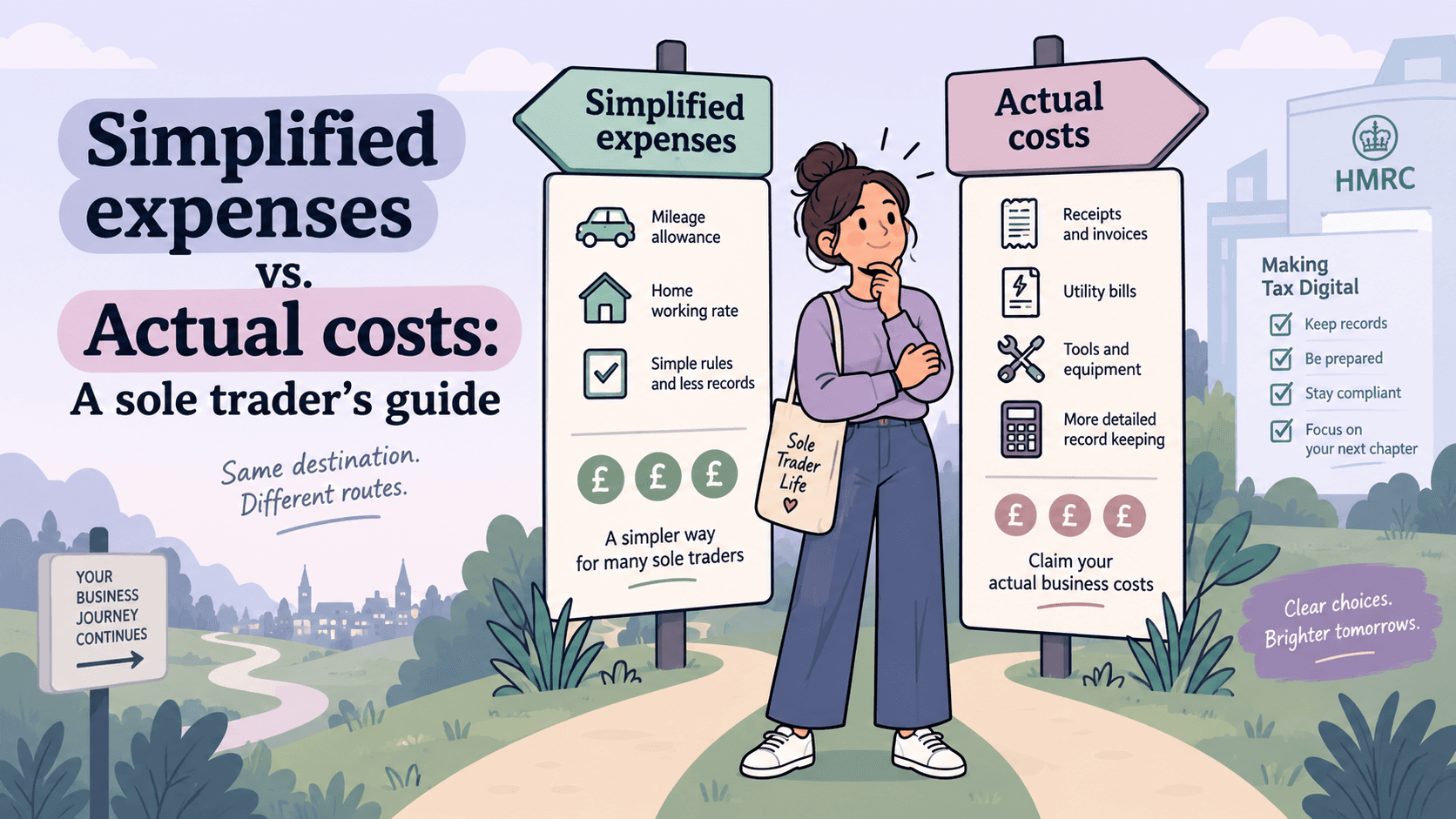
Simplified expenses vs. actual costs: a sole trader's guide.
ONLY£15A MONTHCompare actual costs with simplified expenses, including business mileage and working-from-home rates, and find an approach that fits your business.
When you work for yourself, every penny counts. Claiming your allowable business expenses can reduce your taxable profit—and therefore lower your tax bill.
But when it comes to driving to a client meeting or working from your spare bedroom, calculating how much you can claim gets a bit tricky. HM Revenue & Customs (HMRC) gives eligible sole traders two ways to calculate certain costs: actual costs or simplified expenses.
Making Tax Digital (MTD) for Income Tax started in April 2026 for individuals with qualifying income over £50,000 in 2024–25, unless an exemption applies. If you are within scope, you need digital records and quarterly updates through compatible software. Here is a simple guide to comparing the expense methods.
Method 1: actual costs—the exact maths method.
The actual-costs method involves adding up what you spend and calculating a reasonable business proportion, supported by your records.
For example, if you use your personal mobile phone for business and can demonstrate that 60% of its use is for work, you can generally claim 60% of the relevant bill as an allowable expense.
- The pros: This may result in a higher claim if your allowable business costs exceed the available flat rate. High household or vehicle bills alone do not settle the comparison: the business-use proportion matters too.
- The cons: More admin. You need supporting bills and receipts, plus a record of how you divided business and personal use.
Method 2: simplified expenses—the flat-rate method.
Simplified expenses let eligible sole traders and partnerships without corporate partners use set rates for particular costs. They are optional, and they do not replace record keeping for every business expense. Two common uses are vehicles and working from home; separate rules also cover living at business premises.
1. Vehicles: business mileage.
Instead of claiming the actual costs of buying and running an eligible vehicle, you track qualifying business miles and use these rates:
| Vehicle and mileage | Rate per mile |
|---|---|
| Cars and goods vehicles: first 10,000 business miles | 55p |
| Cars and goods vehicles: business miles above 10,000 | 25p |
| Motorcycles | 24p |
The first-band car and van rate was 45p before 6 April 2026. Check the rate for the tax year you are reporting.
The mileage rate covers vehicle running costs, so you cannot also claim fuel, insurance, or repairs separately for that vehicle. Keep a business-mileage log. Other eligible travel costs, such as parking, can be claimed separately.
You cannot use this method for a vehicle whose purchase cost you have already deducted or for which you have claimed capital allowances. Some vehicles, including dual-control driving-instructor cars and black cabs, are excluded.
2. Working from home.
Rather than dividing relevant household running costs between personal and business use, you can use a monthly flat rate if you work from home for at least 25 hours that month:
| Business hours at home each month | Monthly claim |
|---|---|
| 25–50 hours | £10 |
| 51–100 hours | £18 |
| 101 hours or more | £26 |
Phone and internet costs are not included. You can calculate and claim their business proportion separately using actual costs.
- The pros: Less calculation. For the costs covered by flat rates, you track the relevant miles or hours and apply the rate.
- The cons: A flat-rate claim may be lower than your allowable actual costs. Compare both before deciding, and keep the records that support your choice.
Which method should you choose?
It comes down to your costs, business use, and the time involved in keeping records. Neither method automatically produces the larger claim.
For an inexpensive car with low running costs, flat-rate mileage may compare favourably. For a home office with a substantial business share of household costs, actual costs may be worth calculating. Use HMRC’s simplified expenses checker to compare your figures.
Keep the vehicle rule in mind.
Once you use flat-rate mileage for a vehicle, you must continue using it for as long as that vehicle remains in your business. You do not have to use the same method for all your vehicles.
MTD: keep your records ready.
Whether you calculate actual costs or use flat rates, keep evidence of your claim. For MTD, a paper notebook alone is not enough: the required business records must be kept digitally and quarterly updates sent using compatible software. Spreadsheets can still be used with appropriate bridging software and digital links.
Avona helps you bring connected bank transactions into one place for review and categorisation. For actual-cost claims, keep the supporting bills and record any personal-use adjustment. For simplified expenses, retain your mileage or home-working-hours log and make sure the resulting claim is recorded correctly.
Explore Avona for sole traders, or contact support for help recording expenses in your account.