
Sole traders · Landlords
The dual-income dilemma: managing both property and freelance taxes under MTD.
ONLY£15A MONTHFreelance work and rental income? Understand the combined MTD threshold, separate business updates, and how everything comes together at year end.
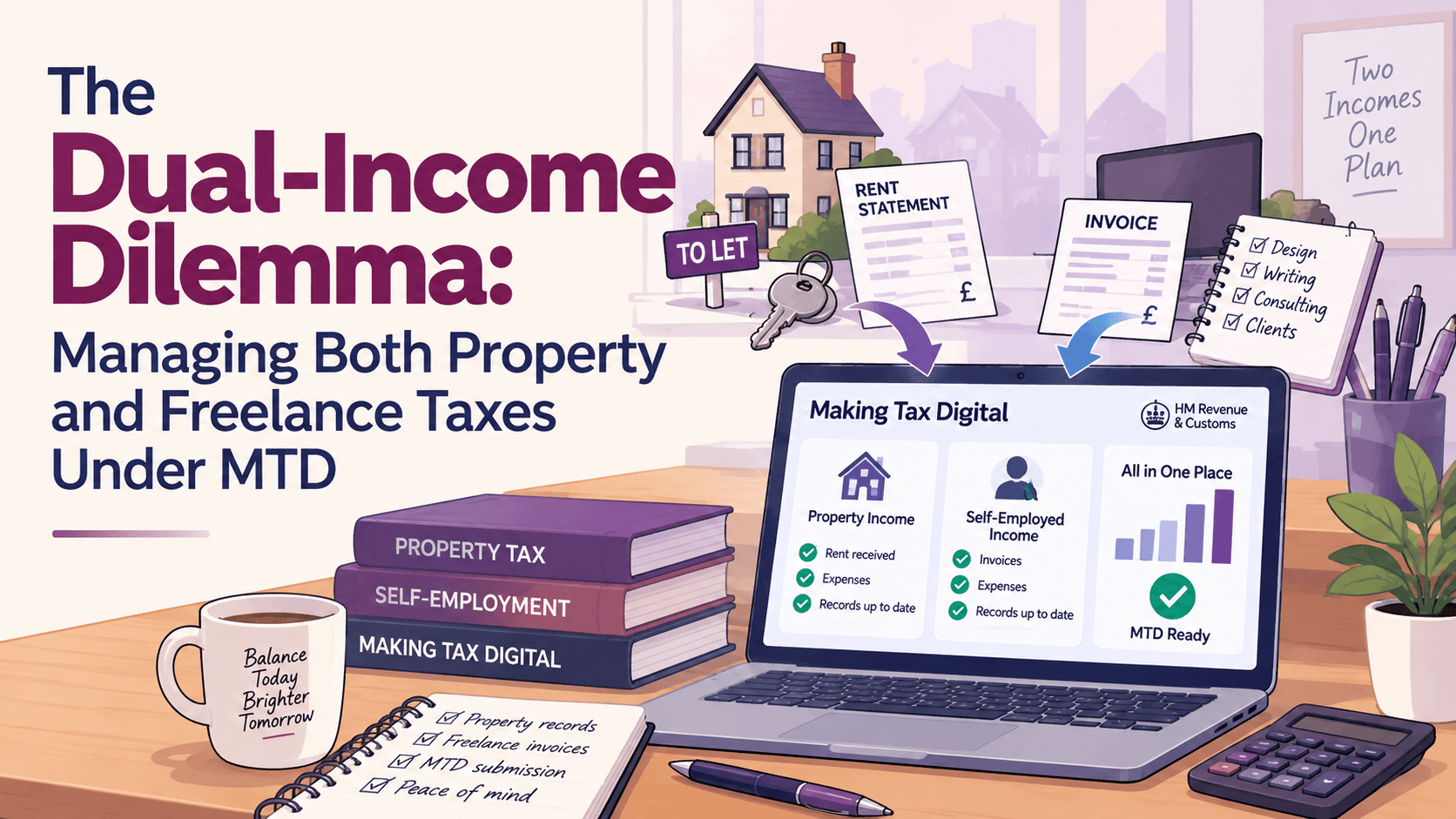
A PAYE day job, a freelance consulting business, and a buy-to-let property: having more than one income stream is familiar territory for many people working in the UK.
While diversifying your income can be good for your finances, it makes your taxes more complicated. With Making Tax Digital for Income Tax starting for the first mandatory group in April 2026, keeping those income streams organised matters more than ever.
If you earn money from both self-employment and property, here is how to navigate the “dual-income dilemma”.
The £50k threshold: the combined rule.
The first hurdle is figuring out whether you need to comply with MTD in 2026. The initial rollout generally applies if your qualifying income exceeded £50,000 in 2024–25, unless an exemption applies.
HMRC looks at your combined gross income from your self-employment and property businesses. You add your freelance sales to your gross rental income before deducting expenses.
The scenario.
Imagine your freelance graphic design business brought in £30,000 in sales during 2024–25, and your rental flat generated £25,000 in gross rent.
- Neither business crosses £50,000 on its own.
- Together, your qualifying income is £55,000.
On those facts, you generally need to use MTD from April 2026. PAYE employment income, dividends, and savings interest do not count towards this threshold.
For more detail, read our guide to the MTD £50k threshold.
Separate businesses, separate quarterly updates.
You cannot lump all your freelance and rental income into one quarterly update. Keep digital records for each business and send the corresponding updates separately.
For one continuing freelance business and one UK property business, that normally means:
- Four quarterly updates for your freelance business.
- Four quarterly updates for your UK property business.
That is eight updates across four quarterly deadline dates, plus your year-end tax return. Your UK rental properties are generally grouped into one UK property business, rather than requiring a separate update for each address. Foreign property is treated as a separate property business; additional self-employments also have their own updates.
| Update | Deadline for both businesses |
|---|---|
| First | 7 August 2026 |
| Second | 7 November 2026 |
| Third | 7 February 2027 |
| Fourth | 7 May 2027 |
Updates are cumulative, covering the year to date. Check that you have selected the correct business before reviewing and sending each one.
HMRC will not issue penalty points for late quarterly updates in 2026–27, but you still need to submit them. This does not remove the rules for late annual tax returns or late payment.
Spreadsheets are not automatically a problem: they can be used with compatible bridging software and the required digital links. The practical challenge is keeping each business’s records complete and correctly separated.
Tying it together: your year-end tax return.
Your quarterly updates remain separate, but your overall tax position comes together in one annual tax return submitted through compatible software. You may see this year-end step described as a “final declaration”; HMRC’s current guidance calls it submitting your tax return.
For the 2026–27 tax year, the deadline is 31 January 2028. Before submitting, check the business figures, make necessary corrections and tax adjustments, claim relevant reliefs, and include or confirm other income such as PAYE earnings and dividends.
Quarterly updates already contain business income and expense totals. The year-end process is where you finalise the full picture, rather than waiting until then to record all your expenses.
How Avona helps untangle the admin.
Separate accounts for freelance work and property can make records easier to follow. Whatever your banking setup, make sure each transaction is assigned to the right business and that personal transactions are identified.
Avona brings connected bank transactions and business records into one place. Review your freelance and property activity separately, check the relevant obligations, and confirm the figures before submitting.
Do not assume a bank feed alone captures everything. Keep supporting receipts, add missing income or expenses, and check any transfers between your accounts so they are not counted twice.
Explore Avona for sole traders and Avona for landlords, or contact support for help organising multiple businesses.